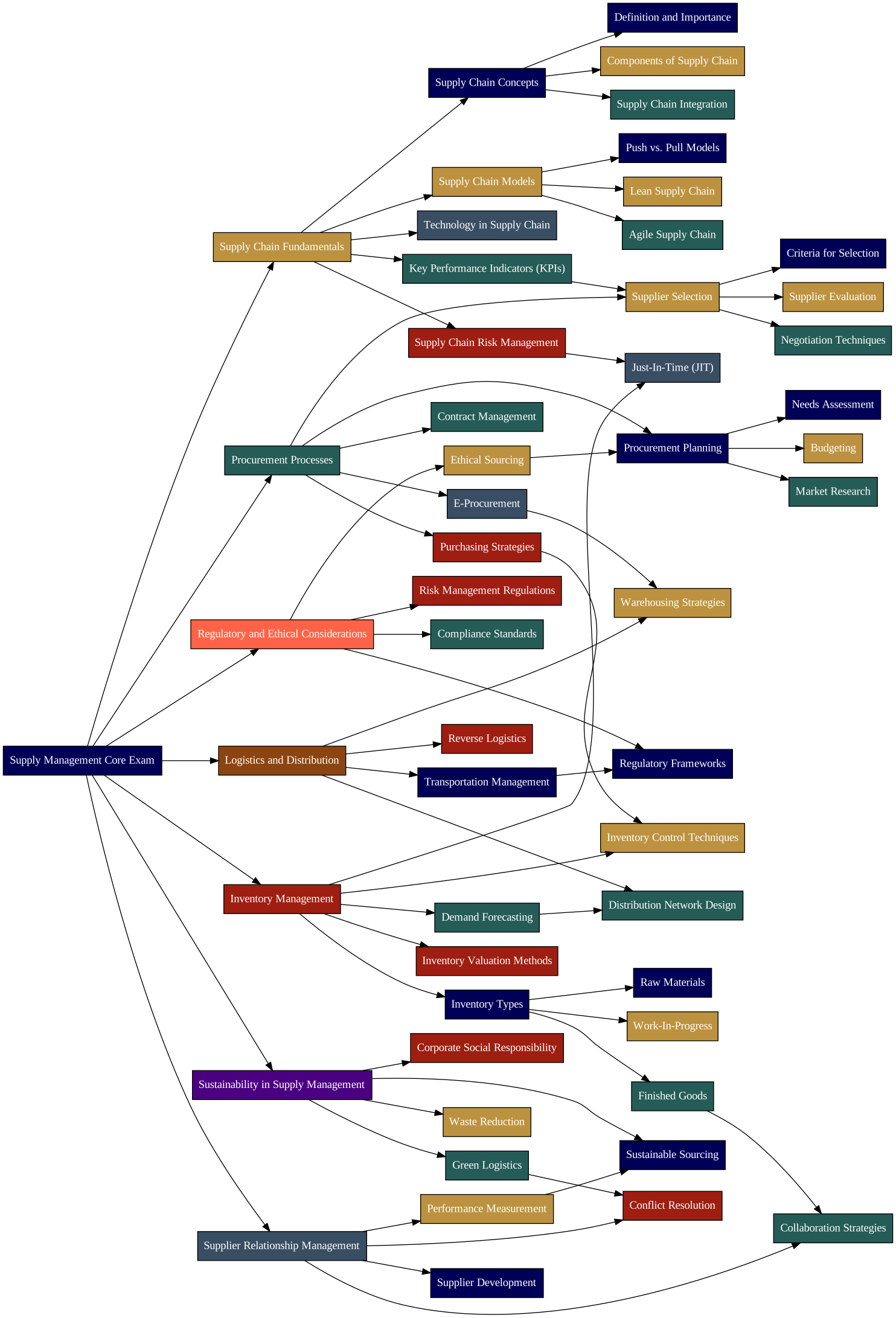

Quiz-summary
0 of 28 questions completed
Questions:
- 1
- 2
- 3
- 4
- 5
- 6
- 7
- 8
- 9
- 10
- 11
- 12
- 13
- 14
- 15
- 16
- 17
- 18
- 19
- 20
- 21
- 22
- 23
- 24
- 25
- 26
- 27
- 28
Information
Premium Practice Questions
You have already completed the quiz before. Hence you can not start it again.
Quiz is loading...
You must sign in or sign up to start the quiz.
You have to finish following quiz, to start this quiz:
Results
0 of 28 questions answered correctly
Your time:
Time has elapsed
Categories
- Not categorized 0%
- 1
- 2
- 3
- 4
- 5
- 6
- 7
- 8
- 9
- 10
- 11
- 12
- 13
- 14
- 15
- 16
- 17
- 18
- 19
- 20
- 21
- 22
- 23
- 24
- 25
- 26
- 27
- 28
- Answered
- Review
-
Question 1 of 28
1. Question
The monitoring system demonstrates that a logistics provider’s registration in the System for Award Management is scheduled to lapse during the final evaluation phase of a major international freight forwarding contract. The provider is currently undergoing a complex merger, which has delayed the update of their organizational profile. Which action represents the most ethical and compliant approach for the provider to ensure they remain eligible for the contract award?
Correct
Correct: Contractors are responsible for maintaining an active and accurate registration in the System for Award Management throughout the entire procurement lifecycle. Ethical conduct in supply chain management requires transparency regarding any administrative hurdles that might affect eligibility. Since an active registration is typically a mandatory condition for receiving a contract award, the provider must prioritize the update and keep the procurement officials informed to maintain the integrity of the competitive process.
Incorrect
Correct: Contractors are responsible for maintaining an active and accurate registration in the System for Award Management throughout the entire procurement lifecycle. Ethical conduct in supply chain management requires transparency regarding any administrative hurdles that might affect eligibility. Since an active registration is typically a mandatory condition for receiving a contract award, the provider must prioritize the update and keep the procurement officials informed to maintain the integrity of the competitive process.
-
Question 2 of 28
2. Question
What factors determine the procedural and ethical responsibilities of a contract manager when an agency leadership team requests the immediate application of a new procurement policy that has not yet been processed through the Federal Acquisition Regulation (FAR) System’s formal update channels?
Correct
Correct: The FAR System is maintained and updated through a structured process involving the FAR Council, the Defense Acquisition Regulations Council (DARC), and the Civilian Agency Acquisition Council (CAAC). This process ensures that regulations are uniform and that the public has an opportunity to comment on significant changes via the Federal Register. Implementing a policy before it has been formally vetted and published violates the procedural requirements of the FAR System and the principles of transparency and uniformity.
Incorrect: Individual agency heads do not have the authority to permanently override the FAR with supplemental regulations without following the proper coordination and deviation procedures. Executive memorandums typically trigger a FAR case but do not automatically amend the regulation without the formal rulemaking process. Internal legal opinions, while valuable for interpretation, cannot legally substitute for the statutory and regulatory requirements of the FAR Council’s formal update procedures.
Takeaway: The integrity of the procurement process depends on following the formal, coordinated rulemaking procedures of the FAR Council and its constituent councils to ensure regulatory consistency.
Incorrect
Correct: The FAR System is maintained and updated through a structured process involving the FAR Council, the Defense Acquisition Regulations Council (DARC), and the Civilian Agency Acquisition Council (CAAC). This process ensures that regulations are uniform and that the public has an opportunity to comment on significant changes via the Federal Register. Implementing a policy before it has been formally vetted and published violates the procedural requirements of the FAR System and the principles of transparency and uniformity.
Incorrect: Individual agency heads do not have the authority to permanently override the FAR with supplemental regulations without following the proper coordination and deviation procedures. Executive memorandums typically trigger a FAR case but do not automatically amend the regulation without the formal rulemaking process. Internal legal opinions, while valuable for interpretation, cannot legally substitute for the statutory and regulatory requirements of the FAR Council’s formal update procedures.
Takeaway: The integrity of the procurement process depends on following the formal, coordinated rulemaking procedures of the FAR Council and its constituent councils to ensure regulatory consistency.
-
Question 3 of 28
3. Question
The analysis reveals that a specific agency’s procurement cycle times for sole-source acquisitions exceeding a certain high-value threshold are significantly higher than the organizational average due to multiple layers of redundant internal review. To optimize this process while fulfilling the regulatory responsibilities of the Head of the Contracting Activity (HCA), which action should the HCA prioritize?
Correct
Correct: The Head of the Contracting Activity (HCA) is responsible for the overall management and effectiveness of the contracting activity. Process optimization is best achieved by establishing efficient internal procedures and delegating authority to the lowest appropriate level allowed by the governing procurement regulations. This ensures that the HCA focuses on high-level strategic oversight while empowered, qualified subordinates handle routine or lower-risk approvals, thereby reducing bottlenecks.
Incorrect: Suspending mandatory documentation like a Justification and Approval (J&A) is a violation of core procurement principles regarding transparency and competition, even in urgent scenarios. Requiring the HCA to personally sign every file is an inefficient management practice that creates a significant bottleneck and fails to utilize the expertise of the contracting workforce. Transferring oversight and compliance functions to a private third party is generally prohibited as these are inherently governmental functions that must remain under the direct accountability of the HCA.
Takeaway: The Head of the Contracting Activity optimizes procurement by balancing rigorous oversight with the strategic delegation of authority to qualified personnel within the contracting activity.
Incorrect
Correct: The Head of the Contracting Activity (HCA) is responsible for the overall management and effectiveness of the contracting activity. Process optimization is best achieved by establishing efficient internal procedures and delegating authority to the lowest appropriate level allowed by the governing procurement regulations. This ensures that the HCA focuses on high-level strategic oversight while empowered, qualified subordinates handle routine or lower-risk approvals, thereby reducing bottlenecks.
Incorrect: Suspending mandatory documentation like a Justification and Approval (J&A) is a violation of core procurement principles regarding transparency and competition, even in urgent scenarios. Requiring the HCA to personally sign every file is an inefficient management practice that creates a significant bottleneck and fails to utilize the expertise of the contracting workforce. Transferring oversight and compliance functions to a private third party is generally prohibited as these are inherently governmental functions that must remain under the direct accountability of the HCA.
Takeaway: The Head of the Contracting Activity optimizes procurement by balancing rigorous oversight with the strategic delegation of authority to qualified personnel within the contracting activity.
-
Question 4 of 28
4. Question
The review process indicates that a contracting officer needs to implement a specific clause variation that deviates from the standard FAR requirements for a single, high-priority research and development contract. To optimize the approval workflow and ensure regulatory compliance under FAR Subpart 1.4, which procedure should the contracting officer follow?
Correct
Correct: According to FAR 1.403, individual deviations affect only one contract action. These deviations may be authorized by the agency head or their designee. The contracting officer is responsible for ensuring that the justification for the deviation is clearly documented and maintained within the official contract file to satisfy audit and compliance requirements.
Incorrect: Class deviations are inappropriate in this scenario because they are intended for multiple contract actions rather than a single specific contract. Contracting officers do not possess inherent authority to deviate from FAR requirements without formal approval from the agency head or a designated authority. The Office of Federal Procurement Policy provides broad policy oversight but does not grant individual contract-level deviations; that authority is delegated to the heads of executive agencies.
Takeaway: Individual deviations from the FAR are authorized at the agency level for specific contract actions and must be formally documented in the contract file.
Incorrect
Correct: According to FAR 1.403, individual deviations affect only one contract action. These deviations may be authorized by the agency head or their designee. The contracting officer is responsible for ensuring that the justification for the deviation is clearly documented and maintained within the official contract file to satisfy audit and compliance requirements.
Incorrect: Class deviations are inappropriate in this scenario because they are intended for multiple contract actions rather than a single specific contract. Contracting officers do not possess inherent authority to deviate from FAR requirements without formal approval from the agency head or a designated authority. The Office of Federal Procurement Policy provides broad policy oversight but does not grant individual contract-level deviations; that authority is delegated to the heads of executive agencies.
Takeaway: Individual deviations from the FAR are authorized at the agency level for specific contract actions and must be formally documented in the contract file.
-
Question 5 of 28
5. Question
Which approach would be most consistent with the Office of Federal Procurement Policy’s mandate to optimize the federal procurement process through the issuance of policy letters and guidance?
Correct
Correct: Establishing government-wide policies that promote economy, efficiency, and effectiveness is the core function of the Office of Federal Procurement Policy. By issuing policy letters and guidance, the office ensures that the procurement system delivers high-quality products and services on a timely basis to meet the needs of the federal government.
Incorrect: Mandating specific technical specifications for every individual agency contract is an operational function of the specific agency and not a government-wide policy role. Directly managing day-to-day source selection activities for major systems acquisitions is the responsibility of agency contracting officers and source selection authorities, not a policy-making office. Exercising exclusive authority to override agency-level protests is a function of oversight bodies and the judicial system rather than the Office of Federal Procurement Policy.
Incorrect
Correct: Establishing government-wide policies that promote economy, efficiency, and effectiveness is the core function of the Office of Federal Procurement Policy. By issuing policy letters and guidance, the office ensures that the procurement system delivers high-quality products and services on a timely basis to meet the needs of the federal government.
Incorrect: Mandating specific technical specifications for every individual agency contract is an operational function of the specific agency and not a government-wide policy role. Directly managing day-to-day source selection activities for major systems acquisitions is the responsibility of agency contracting officers and source selection authorities, not a policy-making office. Exercising exclusive authority to override agency-level protests is a function of oversight bodies and the judicial system rather than the Office of Federal Procurement Policy.
-
Question 6 of 28
6. Question
Assessment of the Guiding Principles for the Federal Acquisition System suggests that when the Acquisition Team identifies a potential process optimization in logistics that is not specifically addressed in the existing regulatory framework, which of the following actions best aligns with the system’s core objectives?
Correct
Correct: The Guiding Principles for the Federal Acquisition System empower the Acquisition Team to exercise initiative and use sound business judgment. Specifically, if a policy or procedure is not prohibited by law or regulation, the team should assume it is permitted if it promotes the best interest of the government. This allows for process optimization and innovation without the need for explicit regulatory permission for every action.
Incorrect: Waiting for formal codification of a procedure is incorrect because the system is designed to be flexible and encourages initiative rather than stagnation. Seeking a formal waiver is unnecessary for actions that are not prohibited, as the system operates on the principle that absence of prohibition implies permission. Limiting optimizations to internal tasks is incorrect because the goal of the Acquisition Team is to maximize value and efficiency across the entire acquisition lifecycle, including external logistics and supply chain interactions.
Takeaway: The Acquisition Team is authorized and encouraged to implement any innovative practice or process optimization that is in the government’s best interest, provided it is not specifically prohibited by law.
Incorrect
Correct: The Guiding Principles for the Federal Acquisition System empower the Acquisition Team to exercise initiative and use sound business judgment. Specifically, if a policy or procedure is not prohibited by law or regulation, the team should assume it is permitted if it promotes the best interest of the government. This allows for process optimization and innovation without the need for explicit regulatory permission for every action.
Incorrect: Waiting for formal codification of a procedure is incorrect because the system is designed to be flexible and encourages initiative rather than stagnation. Seeking a formal waiver is unnecessary for actions that are not prohibited, as the system operates on the principle that absence of prohibition implies permission. Limiting optimizations to internal tasks is incorrect because the goal of the Acquisition Team is to maximize value and efficiency across the entire acquisition lifecycle, including external logistics and supply chain interactions.
Takeaway: The Acquisition Team is authorized and encouraged to implement any innovative practice or process optimization that is in the government’s best interest, provided it is not specifically prohibited by law.
-
Question 7 of 28
7. Question
Risk assessment procedures indicate that a logistics contractor has expanded warehouse operations based on a verbal commitment from a Government site lead who manages daily supply chain activities. The contractor now seeks reimbursement for the additional space and labor costs. Under the Federal Acquisition Regulation (FAR) principles regarding the authority to bind the Government, which statement accurately describes the legal standing of this agreement?
Correct
Correct: According to FAR 1.601 and 1.602-1, only Contracting Officers have the actual authority to enter into, administer, or terminate contracts and make related determinations. Unlike commercial law, the Federal Government does not recognize the doctrine of apparent authority; therefore, the Government is not bound by the actions of agents who lack actual authority, regardless of the contractor’s good faith or the agent’s position.
Incorrect
Correct: According to FAR 1.601 and 1.602-1, only Contracting Officers have the actual authority to enter into, administer, or terminate contracts and make related determinations. Unlike commercial law, the Federal Government does not recognize the doctrine of apparent authority; therefore, the Government is not bound by the actions of agents who lack actual authority, regardless of the contractor’s good faith or the agent’s position.
-
Question 8 of 28
8. Question
During the evaluation of a high-value competitive solicitation for logistics support services, a member of the Technical Evaluation Board (TEB) realizes that their former supervisor from three years ago is now the Vice President of Business Development for one of the offerors. Although the TEB member has no financial interest in the firm, they are concerned about the appearance of a conflict of interest. According to the standards of conduct for Federal employees, what is the most appropriate course of action for the TEB member?
Correct
Correct: Under the standards of conduct regarding impartiality in performing official duties, if an employee has a covered relationship or if circumstances would cause a reasonable person to question their impartiality, the employee must disclose the matter. The Agency Ethics Official or the Contracting Officer must then determine if the employee should be disqualified or if an authorization to participate is appropriate to protect the integrity of the procurement.
Incorrect: Immediate recusal without consultation is not required by regulation and may disrupt the procurement unnecessarily; the decision should be made by an authorized official after a review of the facts. Continuing without disclosure ignores the appearance of partiality standard, which applies even if no direct financial conflict exists. Simply documenting the relationship in the final report fails to address the potential conflict before the evaluation takes place, which could lead to a successful bid protest or a violation of ethics standards.
Takeaway: Federal employees must disclose any relationship that could create an appearance of partiality to an ethics official or the contracting officer to ensure the integrity of the acquisition process.
Incorrect
Correct: Under the standards of conduct regarding impartiality in performing official duties, if an employee has a covered relationship or if circumstances would cause a reasonable person to question their impartiality, the employee must disclose the matter. The Agency Ethics Official or the Contracting Officer must then determine if the employee should be disqualified or if an authorization to participate is appropriate to protect the integrity of the procurement.
Incorrect: Immediate recusal without consultation is not required by regulation and may disrupt the procurement unnecessarily; the decision should be made by an authorized official after a review of the facts. Continuing without disclosure ignores the appearance of partiality standard, which applies even if no direct financial conflict exists. Simply documenting the relationship in the final report fails to address the potential conflict before the evaluation takes place, which could lead to a successful bid protest or a violation of ethics standards.
Takeaway: Federal employees must disclose any relationship that could create an appearance of partiality to an ethics official or the contracting officer to ensure the integrity of the acquisition process.
-
Question 9 of 28
9. Question
Market research demonstrates that when retailers share real-time point of sale (POS) data with their upstream suppliers, the primary strategic advantage for the supplier’s production planning is the mitigation of which supply chain phenomenon?
Correct
Correct: Sharing POS data provides suppliers with direct visibility into actual consumer consumption rather than relying on distorted order signals from the retailer. This visibility significantly reduces the bullwhip effect, where demand fluctuations are amplified as they move up the supply chain. By understanding true demand, suppliers can synchronize their production cycles more accurately, leading to lower inventory costs and improved service levels.
Incorrect: While real-time data is a powerful tool, it does not eliminate the need for historical forecasting because past data is still required to identify seasonality and long-term growth trends. Sharing data is a collaborative effort and does not inherently shift all financial risks or holding costs to the retailer; often, it leads to arrangements like Vendor Managed Inventory where the supplier may actually take on more responsibility. Using POS data to ignore volume signals in favor of high-margin items would lead to stockouts and poor service levels, defeating the purpose of demand-driven planning.
Takeaway: Sharing point of sale data synchronizes the supply chain by providing a single version of demand truth, which minimizes the bullwhip effect and optimizes inventory across the network.
Incorrect
Correct: Sharing POS data provides suppliers with direct visibility into actual consumer consumption rather than relying on distorted order signals from the retailer. This visibility significantly reduces the bullwhip effect, where demand fluctuations are amplified as they move up the supply chain. By understanding true demand, suppliers can synchronize their production cycles more accurately, leading to lower inventory costs and improved service levels.
Incorrect: While real-time data is a powerful tool, it does not eliminate the need for historical forecasting because past data is still required to identify seasonality and long-term growth trends. Sharing data is a collaborative effort and does not inherently shift all financial risks or holding costs to the retailer; often, it leads to arrangements like Vendor Managed Inventory where the supplier may actually take on more responsibility. Using POS data to ignore volume signals in favor of high-margin items would lead to stockouts and poor service levels, defeating the purpose of demand-driven planning.
Takeaway: Sharing point of sale data synchronizes the supply chain by providing a single version of demand truth, which minimizes the bullwhip effect and optimizes inventory across the network.
-
Question 10 of 28
10. Question
Operational review demonstrates that a demand planning team is evaluating the inclusion of a new macroeconomic indicator into their baseline forecasting model. When reviewing the regression output, the lead forecaster observes that the independent variable in question has a p-value of 0.028. If the organization’s standard significance level is set at 0.05, which of the following represents the most appropriate interpretation and action regarding this variable?
Correct
Correct: In statistical significance testing, a p-value represents the probability of obtaining the observed results (or more extreme) assuming the null hypothesis is true. When the p-value (0.028) is less than the predetermined significance level or alpha (0.05), the null hypothesis is rejected. This means the relationship between the independent variable and the forecast target is statistically significant, and the variable provides value to the model.
Incorrect: One incorrect approach confuses the p-value with the probability of the hypothesis being true, which is a common logical fallacy in frequentist statistics. Another approach incorrectly identifies the p-value as the coefficient of determination (R-squared), which measures the proportion of variance explained. The final incorrect approach suggests an arbitrary requirement for logarithmic transformation based on a p-value threshold, which is not a standard statistical or regulatory requirement for significance testing.
Takeaway: An independent variable is considered statistically significant and suitable for a forecasting model when its p-value is lower than the established significance level, typically 0.05 in professional demand planning environments.
Incorrect
Correct: In statistical significance testing, a p-value represents the probability of obtaining the observed results (or more extreme) assuming the null hypothesis is true. When the p-value (0.028) is less than the predetermined significance level or alpha (0.05), the null hypothesis is rejected. This means the relationship between the independent variable and the forecast target is statistically significant, and the variable provides value to the model.
Incorrect: One incorrect approach confuses the p-value with the probability of the hypothesis being true, which is a common logical fallacy in frequentist statistics. Another approach incorrectly identifies the p-value as the coefficient of determination (R-squared), which measures the proportion of variance explained. The final incorrect approach suggests an arbitrary requirement for logarithmic transformation based on a p-value threshold, which is not a standard statistical or regulatory requirement for significance testing.
Takeaway: An independent variable is considered statistically significant and suitable for a forecasting model when its p-value is lower than the established significance level, typically 0.05 in professional demand planning environments.
-
Question 11 of 28
11. Question
The performance metrics show that while the automated statistical baseline forecast maintains a relatively low error rate, the subsequent manual adjustments made during the monthly consensus meeting consistently result in a higher Mean Absolute Percentage Error (MAPE). In the context of Forecast Value Added (FVA) analysis, what is the most appropriate strategic response to improve process efficiency?
Correct
Correct: Forecast Value Added (FVA) analysis is a lean process tool used to identify which steps in the forecasting process improve the forecast and which do not. When a step, such as manual consensus adjustments, consistently shows negative value added (increasing the error compared to the previous step), the most efficient response is to streamline the process. This involves removing the non-value-added activity, often by adopting ‘management by exception’ where only items meeting specific criteria are manually reviewed, while others rely on the more accurate statistical baseline.
Incorrect: Increasing documentation requirements or meeting frequency typically adds process waste and administrative burden without addressing the underlying issue of accuracy degradation. Replacing the statistical model focuses on the wrong part of the process, as the FVA data indicates the human intervention step is the point of failure. Implementing arbitrary smoothing constants or percentage thresholds for adjustments fails to use the FVA evidence to structurally improve the process flow and may mask underlying biases rather than eliminating them.
Takeaway: FVA analysis enables organizations to improve efficiency by identifying and eliminating process steps that consume resources while simultaneously degrading forecast accuracy.
Incorrect
Correct: Forecast Value Added (FVA) analysis is a lean process tool used to identify which steps in the forecasting process improve the forecast and which do not. When a step, such as manual consensus adjustments, consistently shows negative value added (increasing the error compared to the previous step), the most efficient response is to streamline the process. This involves removing the non-value-added activity, often by adopting ‘management by exception’ where only items meeting specific criteria are manually reviewed, while others rely on the more accurate statistical baseline.
Incorrect: Increasing documentation requirements or meeting frequency typically adds process waste and administrative burden without addressing the underlying issue of accuracy degradation. Replacing the statistical model focuses on the wrong part of the process, as the FVA data indicates the human intervention step is the point of failure. Implementing arbitrary smoothing constants or percentage thresholds for adjustments fails to use the FVA evidence to structurally improve the process flow and may mask underlying biases rather than eliminating them.
Takeaway: FVA analysis enables organizations to improve efficiency by identifying and eliminating process steps that consume resources while simultaneously degrading forecast accuracy.
-
Question 12 of 28
12. Question
When evaluating the effectiveness of a product portfolio review within an integrated planning cycle, which process optimization strategy best ensures that the demand plan remains realistic and aligned with strategic objectives?
Correct
Correct: A formal stage-gate review process is essential for process optimization in portfolio management. It ensures that the demand plan is not just a list of desires, but a feasible plan that accounts for the operational realities of supply chain capacity and the transition from old products to new ones. This synchronization prevents inventory bloat from overlapping lifecycles and ensures that the forecast is grounded in the organization’s actual ability to deliver.
Incorrect: Including all marketing initiatives without validation leads to significant forecast bias and operational strain. Relying exclusively on inventory turnover for rationalization is a narrow approach that ignores strategic product importance, contribution margins, or customer segmentation needs. Keeping a short-term supply plan static while extending the long-term horizon creates a disconnect between strategic planning and tactical execution, leading to agility failures.
Takeaway: Effective product portfolio management requires the synchronization of product lifecycles with operational constraints to maintain a credible and executable demand plan within the planning cycle.
Incorrect
Correct: A formal stage-gate review process is essential for process optimization in portfolio management. It ensures that the demand plan is not just a list of desires, but a feasible plan that accounts for the operational realities of supply chain capacity and the transition from old products to new ones. This synchronization prevents inventory bloat from overlapping lifecycles and ensures that the forecast is grounded in the organization’s actual ability to deliver.
Incorrect: Including all marketing initiatives without validation leads to significant forecast bias and operational strain. Relying exclusively on inventory turnover for rationalization is a narrow approach that ignores strategic product importance, contribution margins, or customer segmentation needs. Keeping a short-term supply plan static while extending the long-term horizon creates a disconnect between strategic planning and tactical execution, leading to agility failures.
Takeaway: Effective product portfolio management requires the synchronization of product lifecycles with operational constraints to maintain a credible and executable demand plan within the planning cycle.
-
Question 13 of 28
13. Question
The control framework reveals that a manufacturing firm is experiencing significant volatility in production schedules despite relatively stable consumer demand at the retail level. Upon performing an impact assessment of the supply chain dynamics, which of the following behaviors is most likely contributing to this amplification of demand variability as it moves upstream?
Correct
Correct: Order batching is a classic cause of the bullwhip effect. When a firm waits to accumulate orders to reach a full truckload or a specific volume discount, it creates artificial spikes in demand for the upstream supplier. This behavior obscures the actual consumer demand signal, leading to increased variance and inventory instability further up the supply chain.
Incorrect: Vendor Managed Inventory (VMI) and the use of Point-of-Sale (POS) data are strategies specifically designed to mitigate the bullwhip effect by increasing visibility and ensuring that all tiers react to the same demand signal. Reducing lead times through cross-docking also helps minimize the bullwhip effect by allowing the supply chain to be more responsive to actual changes in demand rather than relying on long-term forecasts.
Takeaway: The bullwhip effect is often exacerbated by operational decisions like order batching that prioritize local cost efficiencies over total supply chain demand visibility.
Incorrect
Correct: Order batching is a classic cause of the bullwhip effect. When a firm waits to accumulate orders to reach a full truckload or a specific volume discount, it creates artificial spikes in demand for the upstream supplier. This behavior obscures the actual consumer demand signal, leading to increased variance and inventory instability further up the supply chain.
Incorrect: Vendor Managed Inventory (VMI) and the use of Point-of-Sale (POS) data are strategies specifically designed to mitigate the bullwhip effect by increasing visibility and ensuring that all tiers react to the same demand signal. Reducing lead times through cross-docking also helps minimize the bullwhip effect by allowing the supply chain to be more responsive to actual changes in demand rather than relying on long-term forecasts.
Takeaway: The bullwhip effect is often exacerbated by operational decisions like order batching that prioritize local cost efficiencies over total supply chain demand visibility.
-
Question 14 of 28
14. Question
Upon reviewing the upcoming seasonal promotion for a high-demand consumer good, a manufacturer and a retailer find that their individual demand forecasts for the promotional period differ significantly. To ensure the success of the promotion and minimize supply chain disruptions, which collaborative approach should the partners prioritize to align their planning efforts?
Correct
Correct: Establishing a joint business plan is a fundamental step in Collaborative Planning, Forecasting, and Replenishment (CPFR). By sharing promotional calendars and lift factors—the estimated increase in sales volume due to the promotion—and using actual point-of-sale data, both parties synchronize their expectations. This transparency reduces the bullwhip effect and ensures that production and inventory levels are aligned with actual consumer demand rather than internal silos.
Incorrect: Relying on historical shipment data is flawed because it reflects past supply capabilities rather than future promotional demand. Independent adjustments by the retailer without sharing promotional strategies lead to information asymmetry and stockouts. Averaging forecasts through a third party is a reactive measure that fails to address the strategic misalignment and lacks the granular insight provided by direct collaboration on lift factors and promotional timing.
Takeaway: Successful retail-manufacturer collaboration requires the integration of shared strategic goals and real-time demand data to synchronize the entire supply chain for promotional events.
Incorrect
Correct: Establishing a joint business plan is a fundamental step in Collaborative Planning, Forecasting, and Replenishment (CPFR). By sharing promotional calendars and lift factors—the estimated increase in sales volume due to the promotion—and using actual point-of-sale data, both parties synchronize their expectations. This transparency reduces the bullwhip effect and ensures that production and inventory levels are aligned with actual consumer demand rather than internal silos.
Incorrect: Relying on historical shipment data is flawed because it reflects past supply capabilities rather than future promotional demand. Independent adjustments by the retailer without sharing promotional strategies lead to information asymmetry and stockouts. Averaging forecasts through a third party is a reactive measure that fails to address the strategic misalignment and lacks the granular insight provided by direct collaboration on lift factors and promotional timing.
Takeaway: Successful retail-manufacturer collaboration requires the integration of shared strategic goals and real-time demand data to synchronize the entire supply chain for promotional events.
-
Question 15 of 28
15. Question
Compliance review shows that a regional distribution center is struggling to evaluate forecast accuracy for spare parts characterized by intermittent demand and frequent zero-demand periods. The planning team is considering transitioning from standard Mean Absolute Percentage Error (MAPE) to symmetric Mean Absolute Percentage Error (sMAPE) to optimize their performance reporting process. Which of the following best describes the conceptual advantage of using sMAPE in this specific scenario?
Correct
Correct: In supply chain forecasting, the standard MAPE formula fails when actual demand is zero because it requires division by the actual value, resulting in an undefined or infinite error. sMAPE (symmetric Mean Absolute Percentage Error) addresses this by using the average of the actual and forecast values in the denominator. This allows the metric to produce a valid, bounded percentage even during periods of zero demand, as long as the forecast itself is not also zero, making it a more robust process tool for intermittent demand patterns.
Incorrect: The suggestion that sMAPE weights errors against a historical mean is incorrect, as sMAPE still relies on period-specific values for its denominator. The idea that sMAPE is chosen simply to produce lower error values for stakeholder reporting is a misunderstanding of statistical integrity and process optimization. Finally, sMAPE is intended to be symmetric in its treatment of over and under-forecasts; it does not inherently penalize positive errors more heavily to prevent stockouts, which would be a function of safety stock logic or biased loss functions rather than a standard accuracy metric.
Takeaway: sMAPE is a preferred metric for intermittent demand because it remains mathematically defined during zero-demand periods by incorporating the forecast value into the denominator.
Incorrect
Correct: In supply chain forecasting, the standard MAPE formula fails when actual demand is zero because it requires division by the actual value, resulting in an undefined or infinite error. sMAPE (symmetric Mean Absolute Percentage Error) addresses this by using the average of the actual and forecast values in the denominator. This allows the metric to produce a valid, bounded percentage even during periods of zero demand, as long as the forecast itself is not also zero, making it a more robust process tool for intermittent demand patterns.
Incorrect: The suggestion that sMAPE weights errors against a historical mean is incorrect, as sMAPE still relies on period-specific values for its denominator. The idea that sMAPE is chosen simply to produce lower error values for stakeholder reporting is a misunderstanding of statistical integrity and process optimization. Finally, sMAPE is intended to be symmetric in its treatment of over and under-forecasts; it does not inherently penalize positive errors more heavily to prevent stockouts, which would be a function of safety stock logic or biased loss functions rather than a standard accuracy metric.
Takeaway: sMAPE is a preferred metric for intermittent demand because it remains mathematically defined during zero-demand periods by incorporating the forecast value into the denominator.
-
Question 16 of 28
16. Question
Examination of the data shows a single-period spike in demand followed by a sustained upward shift in the baseline four months later. According to professional forecasting standards for data cleansing and historical maintenance, what is the most appropriate method to address these two distinct data anomalies?
Correct
Correct: Professional forecasting standards require a qualitative assessment of data anomalies. An outlier is typically a one-time event (transient) that should be adjusted to a ‘normal’ level so it does not skew future projections. Conversely, a level shift represents a structural change in the business environment (such as a new permanent contract or market expansion) and must be recognized as the new baseline for the forecast to remain accurate.
Incorrect: Applying smoothing techniques without intervention often results in a forecast that lags behind actual demand shifts and remains biased by the outlier. Removing data points entirely creates gaps in the time series and loses the context of the level shift. Treating structural changes as random noise leads to persistent forecast errors, stockouts, or excess inventory because the model fails to adapt to the new market reality.
Takeaway: Forecasters must differentiate between temporary outliers and permanent level shifts to ensure historical data accurately reflects the current demand environment.
Incorrect
Correct: Professional forecasting standards require a qualitative assessment of data anomalies. An outlier is typically a one-time event (transient) that should be adjusted to a ‘normal’ level so it does not skew future projections. Conversely, a level shift represents a structural change in the business environment (such as a new permanent contract or market expansion) and must be recognized as the new baseline for the forecast to remain accurate.
Incorrect: Applying smoothing techniques without intervention often results in a forecast that lags behind actual demand shifts and remains biased by the outlier. Removing data points entirely creates gaps in the time series and loses the context of the level shift. Treating structural changes as random noise leads to persistent forecast errors, stockouts, or excess inventory because the model fails to adapt to the new market reality.
Takeaway: Forecasters must differentiate between temporary outliers and permanent level shifts to ensure historical data accurately reflects the current demand environment.
-
Question 17 of 28
17. Question
Strategic planning requires a forecaster to select the most appropriate smoothing technique to align production schedules with recent market shifts. When presenting a demand plan to the Operations Manager, why might a Weighted Moving Average (WMA) be preferred over a Simple Moving Average (SMA) for a product line experiencing a recent, sustained increase in promotional activity?
Correct
Correct: A Weighted Moving Average (WMA) is specifically used when more recent data is more indicative of future demand than older data. By assigning higher weights to recent periods, the forecast reacts more quickly to changes in demand patterns, such as those caused by promotions, effectively reducing the ‘lag’ that occurs when using a Simple Moving Average (SMA) which treats all data points equally.
Incorrect: Focusing exclusively on the most recent period is a naive forecast approach, not a moving average, and it increases the risk of overreacting to random noise. The description of a single, unweighted average refers to the Simple Moving Average (SMA), which is often criticized for being too slow to react to trends. Finally, WMA does not inherently account for seasonality; seasonal adjustments require specific decomposition methods or seasonal indices rather than just chronological weighting.
Takeaway: Weighted Moving Averages offer greater responsiveness to recent demand shifts compared to Simple Moving Averages by allowing forecasters to emphasize the most relevant recent data.
Incorrect
Correct: A Weighted Moving Average (WMA) is specifically used when more recent data is more indicative of future demand than older data. By assigning higher weights to recent periods, the forecast reacts more quickly to changes in demand patterns, such as those caused by promotions, effectively reducing the ‘lag’ that occurs when using a Simple Moving Average (SMA) which treats all data points equally.
Incorrect: Focusing exclusively on the most recent period is a naive forecast approach, not a moving average, and it increases the risk of overreacting to random noise. The description of a single, unweighted average refers to the Simple Moving Average (SMA), which is often criticized for being too slow to react to trends. Finally, WMA does not inherently account for seasonality; seasonal adjustments require specific decomposition methods or seasonal indices rather than just chronological weighting.
Takeaway: Weighted Moving Averages offer greater responsiveness to recent demand shifts compared to Simple Moving Averages by allowing forecasters to emphasize the most relevant recent data.
-
Question 18 of 28
18. Question
The assessment process reveals that a demand planner has identified a strong statistical relationship between the number of social media mentions and the weekly sales volume of a specific consumer good. When integrating this finding into the demand model, which approach best demonstrates an understanding of the distinction between correlation and causation?
Correct
Correct: The correct approach involves validating the underlying driver of the relationship. In demand forecasting, correlation measures how two variables move together, but it does not prove that one causes the other. By investigating whether a third factor, such as a planned marketing campaign, is actually driving both the social media mentions and the sales, the forecaster avoids building a model based on spurious correlation, which would likely fail if the external factor changed.
Incorrect: Relying solely on high R-squared values is a common mistake because statistical fit does not equate to a logical causal link. Replacing established macroeconomic drivers with a new metric simply because of a higher correlation coefficient can lead to model instability if the new metric lacks a logical connection to consumer behavior. Finally, temporal precedence (one event occurring before another) is a necessary condition for causation but is not sufficient evidence on its own to prove a causal relationship, as both could be lagging indicators of a different root cause.
Takeaway: A professional forecaster must distinguish between statistical association and functional drivers to ensure demand models remain robust when external conditions shift.
Incorrect
Correct: The correct approach involves validating the underlying driver of the relationship. In demand forecasting, correlation measures how two variables move together, but it does not prove that one causes the other. By investigating whether a third factor, such as a planned marketing campaign, is actually driving both the social media mentions and the sales, the forecaster avoids building a model based on spurious correlation, which would likely fail if the external factor changed.
Incorrect: Relying solely on high R-squared values is a common mistake because statistical fit does not equate to a logical causal link. Replacing established macroeconomic drivers with a new metric simply because of a higher correlation coefficient can lead to model instability if the new metric lacks a logical connection to consumer behavior. Finally, temporal precedence (one event occurring before another) is a necessary condition for causation but is not sufficient evidence on its own to prove a causal relationship, as both could be lagging indicators of a different root cause.
Takeaway: A professional forecaster must distinguish between statistical association and functional drivers to ensure demand models remain robust when external conditions shift.
-
Question 19 of 28
19. Question
The evaluation methodology shows that a demand planner is attempting to isolate seasonal indices for a product line where the magnitude of seasonal variation increases proportionally with the overall sales trend. Which approach to classical decomposition is most appropriate for accurately capturing these seasonal effects, and why?
Correct
Correct: Multiplicative decomposition is the standard choice when the seasonal swing increases or decreases in size as the trend level changes. In this model, the seasonal component is expressed as a ratio or percentage of the trend, making it dynamic relative to the volume. This ensures that as the business grows, the forecasted seasonal peaks and valleys scale appropriately.
Incorrect: Additive decomposition is unsuitable for this scenario because it assumes seasonal effects are constant in absolute units (e.g., always 500 units more in Q4), which would lead to under-forecasting seasonality as the trend grows. Simple moving averages are primarily used for smoothing noise and do not provide a structured methodology for isolating and re-applying seasonal indices. High alpha factors in exponential smoothing relate to the weight given to recent data points for level and trend updates, rather than the structural decomposition of time series components into indices.
Takeaway: Multiplicative decomposition should be used when seasonal variation is proportional to the trend, while additive decomposition is reserved for series where seasonal variation is constant in magnitude.
Incorrect
Correct: Multiplicative decomposition is the standard choice when the seasonal swing increases or decreases in size as the trend level changes. In this model, the seasonal component is expressed as a ratio or percentage of the trend, making it dynamic relative to the volume. This ensures that as the business grows, the forecasted seasonal peaks and valleys scale appropriately.
Incorrect: Additive decomposition is unsuitable for this scenario because it assumes seasonal effects are constant in absolute units (e.g., always 500 units more in Q4), which would lead to under-forecasting seasonality as the trend grows. Simple moving averages are primarily used for smoothing noise and do not provide a structured methodology for isolating and re-applying seasonal indices. High alpha factors in exponential smoothing relate to the weight given to recent data points for level and trend updates, rather than the structural decomposition of time series components into indices.
Takeaway: Multiplicative decomposition should be used when seasonal variation is proportional to the trend, while additive decomposition is reserved for series where seasonal variation is constant in magnitude.
-
Question 20 of 28
20. Question
The investigation demonstrates that a senior demand planner at a logistics firm has discovered a significant discrepancy between the promotional data stored in the central data warehouse and the manual spreadsheets maintained by the regional sales team. The sales team is pressuring the planner to use their manual figures, which reflect higher projected demand, to secure larger inventory buffers for an upcoming peak season, despite the data warehouse records indicating a historical trend of over-forecasting in that specific region. What is the most ethically and professionally sound action for the planner to take to ensure the integrity of the demand planning process?
Correct
Correct: The data warehouse is designed to provide a single version of the truth by consolidating and cleaning historical data from disparate sources. Professional forecasting ethics require the planner to rely on validated, objective data to minimize forecast bias. By using the data warehouse as the baseline and treating sales input as a qualitative overlay, the planner maintains transparency and data integrity while still allowing for human insight to be considered in the formal S&OP process.
Incorrect: Adopting manual figures without validation introduces significant forecast bias and undermines the purpose of a centralized data repository. Averaging disparate data sets is a non-statistical approach that lacks methodological rigor and fails to address the underlying data discrepancy. Modifying the data warehouse to match unverified manual records is a violation of data governance principles and corrupts the historical record used for future planning cycles.
Takeaway: A data warehouse provides the objective foundation for demand planning, and planners must protect its role as the single version of the truth against departmental biases and manual data manipulation.
Incorrect
Correct: The data warehouse is designed to provide a single version of the truth by consolidating and cleaning historical data from disparate sources. Professional forecasting ethics require the planner to rely on validated, objective data to minimize forecast bias. By using the data warehouse as the baseline and treating sales input as a qualitative overlay, the planner maintains transparency and data integrity while still allowing for human insight to be considered in the formal S&OP process.
Incorrect: Adopting manual figures without validation introduces significant forecast bias and undermines the purpose of a centralized data repository. Averaging disparate data sets is a non-statistical approach that lacks methodological rigor and fails to address the underlying data discrepancy. Modifying the data warehouse to match unverified manual records is a violation of data governance principles and corrupts the historical record used for future planning cycles.
Takeaway: A data warehouse provides the objective foundation for demand planning, and planners must protect its role as the single version of the truth against departmental biases and manual data manipulation.
-
Question 21 of 28
21. Question
Performance analysis shows that Product Line X has a Mean Percentage Error (MPE) of -12% over the last fiscal year, while Product Line Y has an MPE of +3% during the same period. When comparing these two performance metrics to adjust the supply chain strategy, which interpretation of the forecast bias is most accurate?
Correct
Correct: Mean Percentage Error (MPE) is the standard metric used to identify systematic bias in forecasting. A negative MPE indicates that the forecasts are consistently higher than the actual demand (over-forecasting), which leads to excess inventory, increased storage costs, and potential obsolescence. A positive MPE indicates that forecasts are consistently lower than actual demand (under-forecasting), which can lead to stockouts and lost revenue. In this scenario, Product Line X’s -12% MPE signifies a significant over-forecasting bias compared to the relatively low under-forecasting bias of Product Line Y.
Incorrect: One interpretation incorrectly suggests that a negative MPE is a sign of efficiency or proactive waste reduction, when it actually represents a systematic error in overestimating demand. Another interpretation confuses the direction of the error, falsely stating that negative MPE means forecasts are smaller than actuals; in reality, negative MPE means actuals are smaller than forecasts. Finally, claiming MPE measures absolute volume or random variation is incorrect, as MPE is specifically designed to detect directional bias, while metrics like Mean Absolute Percentage Error (MAPE) are used to measure the magnitude of error.
Takeaway: Mean Percentage Error (MPE) identifies systematic forecast bias, where negative values signify over-forecasting and positive values signify under-forecasting.
Incorrect
Correct: Mean Percentage Error (MPE) is the standard metric used to identify systematic bias in forecasting. A negative MPE indicates that the forecasts are consistently higher than the actual demand (over-forecasting), which leads to excess inventory, increased storage costs, and potential obsolescence. A positive MPE indicates that forecasts are consistently lower than actual demand (under-forecasting), which can lead to stockouts and lost revenue. In this scenario, Product Line X’s -12% MPE signifies a significant over-forecasting bias compared to the relatively low under-forecasting bias of Product Line Y.
Incorrect: One interpretation incorrectly suggests that a negative MPE is a sign of efficiency or proactive waste reduction, when it actually represents a systematic error in overestimating demand. Another interpretation confuses the direction of the error, falsely stating that negative MPE means forecasts are smaller than actuals; in reality, negative MPE means actuals are smaller than forecasts. Finally, claiming MPE measures absolute volume or random variation is incorrect, as MPE is specifically designed to detect directional bias, while metrics like Mean Absolute Percentage Error (MAPE) are used to measure the magnitude of error.
Takeaway: Mean Percentage Error (MPE) identifies systematic forecast bias, where negative values signify over-forecasting and positive values signify under-forecasting.
-
Question 22 of 28
22. Question
Research into the integration of downstream demand signals within a Distribution Requirements Planning (DRP) framework suggests that the most effective way to optimize the replenishment process across a multi-echelon network is to:
Correct
Correct: Integrating real-time demand signals, such as point-of-sale (POS) data, into the DRP process allows the supply chain to move from a reactive ‘push’ system to a more responsive ‘pull’ system. By synchronizing time-phased replenishment with actual consumption, the organization can reduce the bullwhip effect, lower overall inventory levels, and ensure that stock is positioned according to current market needs rather than outdated forecasts.
Incorrect: Increasing safety stock levels is a traditional inventory buffering technique that addresses the symptoms of demand variability rather than optimizing the process through better information. Transitioning to fixed-order quantities often ignores the time-phased requirements of a distribution network, leading to inefficiencies in transportation and storage. Relying solely on central warehouse availability ignores the fundamental principle of DRP, which is to satisfy requirements at the point of demand, potentially leading to stockouts in high-demand areas while overstocking others.
Takeaway: Optimizing DRP requires the synchronization of time-phased planning with actual demand signals to improve responsiveness and reduce the distortion of demand information throughout the supply chain.
Incorrect
Correct: Integrating real-time demand signals, such as point-of-sale (POS) data, into the DRP process allows the supply chain to move from a reactive ‘push’ system to a more responsive ‘pull’ system. By synchronizing time-phased replenishment with actual consumption, the organization can reduce the bullwhip effect, lower overall inventory levels, and ensure that stock is positioned according to current market needs rather than outdated forecasts.
Incorrect: Increasing safety stock levels is a traditional inventory buffering technique that addresses the symptoms of demand variability rather than optimizing the process through better information. Transitioning to fixed-order quantities often ignores the time-phased requirements of a distribution network, leading to inefficiencies in transportation and storage. Relying solely on central warehouse availability ignores the fundamental principle of DRP, which is to satisfy requirements at the point of demand, potentially leading to stockouts in high-demand areas while overstocking others.
Takeaway: Optimizing DRP requires the synchronization of time-phased planning with actual demand signals to improve responsiveness and reduce the distortion of demand information throughout the supply chain.
-
Question 23 of 28
23. Question
Market research demonstrates that the effectiveness of the Integrated Business Planning (IBP) cycle hinges on the integrity of the Demand Review meeting. In a comparative analysis of organizational planning structures, which of the following best describes the primary objective of the Demand Review meeting relative to the subsequent Supply Review meeting?
Correct
Correct: The Demand Review meeting is designed to produce an unconstrained forecast. This means the team focuses on what the market is expected to demand based on sales insights, marketing promotions, and economic trends, without yet limiting those numbers by what the factory can produce. This unconstrained view is essential because it allows the subsequent Supply Review to identify exactly where capacity or material gaps exist, enabling better strategic decision-making.
Incorrect: Adjusting the plan for manufacturing and warehouse constraints is the primary function of the Supply Review, not the Demand Review. Finalizing financial budgets is typically handled during the Financial Integration or Executive S&OP meeting, which occurs after demand and supply have been balanced. Performing detailed SKU-level statistical cleaning is a prerequisite step known as Data Preparation, which should occur before the Demand Review meeting to ensure the team is working with clean data during the consensus process.
Takeaway: The Demand Review must focus on unconstrained market demand to provide a clear signal for identifying supply chain gaps in later stages of the planning cycle.
Incorrect
Correct: The Demand Review meeting is designed to produce an unconstrained forecast. This means the team focuses on what the market is expected to demand based on sales insights, marketing promotions, and economic trends, without yet limiting those numbers by what the factory can produce. This unconstrained view is essential because it allows the subsequent Supply Review to identify exactly where capacity or material gaps exist, enabling better strategic decision-making.
Incorrect: Adjusting the plan for manufacturing and warehouse constraints is the primary function of the Supply Review, not the Demand Review. Finalizing financial budgets is typically handled during the Financial Integration or Executive S&OP meeting, which occurs after demand and supply have been balanced. Performing detailed SKU-level statistical cleaning is a prerequisite step known as Data Preparation, which should occur before the Demand Review meeting to ensure the team is working with clean data during the consensus process.
Takeaway: The Demand Review must focus on unconstrained market demand to provide a clear signal for identifying supply chain gaps in later stages of the planning cycle.
-
Question 24 of 28
24. Question
The performance metrics show that the baseline forecast for a high-volume consumer good is consistently over-forecasting during non-promotional periods because historical data includes significant sales spikes from deep-discount events. To improve the accuracy of the statistical baseline, which implementation strategy should the demand planner prioritize for data cleansing?
Correct
Correct: In demand planning and forecasting, promotional noise must be removed to identify the underlying base demand. The most effective way to cleanse this data is to isolate the ‘lift’ (the incremental volume generated by the promotion) and replace the promotional data points with a representative baseline, such as an average of adjacent non-promotional periods. This ensures the statistical model identifies the true trend and seasonality without being skewed by artificial demand spikes.
Incorrect: Adjusting the entire dataset by a fixed percentage is an oversimplification that fails to account for the specific timing and impact of promotions, leading to errors in both base and peak periods. Including promotional spikes in a simple moving average results in a ‘smeared’ forecast that overestimates demand during quiet periods and underestimates it during peaks. Treating promotional periods as missing values can lead to a loss of critical trend data and may cause the forecasting algorithm to generate erratic results if promotions occur frequently.
Takeaway: Effective data cleansing requires isolating promotional lift from base demand to prevent historical spikes from distorting the statistical baseline forecast.
Incorrect
Correct: In demand planning and forecasting, promotional noise must be removed to identify the underlying base demand. The most effective way to cleanse this data is to isolate the ‘lift’ (the incremental volume generated by the promotion) and replace the promotional data points with a representative baseline, such as an average of adjacent non-promotional periods. This ensures the statistical model identifies the true trend and seasonality without being skewed by artificial demand spikes.
Incorrect: Adjusting the entire dataset by a fixed percentage is an oversimplification that fails to account for the specific timing and impact of promotions, leading to errors in both base and peak periods. Including promotional spikes in a simple moving average results in a ‘smeared’ forecast that overestimates demand during quiet periods and underestimates it during peaks. Treating promotional periods as missing values can lead to a loss of critical trend data and may cause the forecasting algorithm to generate erratic results if promotions occur frequently.
Takeaway: Effective data cleansing requires isolating promotional lift from base demand to prevent historical spikes from distorting the statistical baseline forecast.
-
Question 25 of 28
25. Question
The evaluation methodology shows that a logistics firm is attempting to refine its demand forecasting for heavy machinery spare parts by utilizing the Purchasing Managers’ Index (PMI) as a leading indicator. When constructing a multiple regression model to improve the accuracy of the three-month-ahead forecast, how should the forecaster technically treat the PMI variable to ensure it provides predictive value?
Correct
Correct: In regression analysis for forecasting, leading indicators must be ‘lagged’ to be useful. By shifting the independent variable (PMI) back in time (e.g., using PMI from month t-3 to predict demand at month t), the forecaster aligns the historical cause-and-effect relationship. This allows the model to use currently available data to predict future outcomes, which is the primary purpose of a leading indicator in a supply chain context.
Incorrect: Aggregating data into annual averages loses the granularity needed for monthly demand planning and ignores the lead-lag relationship. Using the variable contemporaneously fails to provide any predictive ‘lead’ time, as you would need the future PMI to predict future demand. Categorizing a continuous leading indicator into qualitative tiers loses significant statistical information and reduces the precision of the regression model’s predictive power.
Takeaway: To utilize leading indicators effectively in regression, the independent variable must be lagged to align its historical movements with the subsequent impacts on the dependent variable.
Incorrect
Correct: In regression analysis for forecasting, leading indicators must be ‘lagged’ to be useful. By shifting the independent variable (PMI) back in time (e.g., using PMI from month t-3 to predict demand at month t), the forecaster aligns the historical cause-and-effect relationship. This allows the model to use currently available data to predict future outcomes, which is the primary purpose of a leading indicator in a supply chain context.
Incorrect: Aggregating data into annual averages loses the granularity needed for monthly demand planning and ignores the lead-lag relationship. Using the variable contemporaneously fails to provide any predictive ‘lead’ time, as you would need the future PMI to predict future demand. Categorizing a continuous leading indicator into qualitative tiers loses significant statistical information and reduces the precision of the regression model’s predictive power.
Takeaway: To utilize leading indicators effectively in regression, the independent variable must be lagged to align its historical movements with the subsequent impacts on the dependent variable.
-
Question 26 of 28
26. Question
Consider a scenario where a heavy equipment manufacturer is refining its integrated business planning process. The company produces finished excavators for external sale and also manufactures the hydraulic cylinders used within those excavators. The planning department is currently debating the most effective method for determining the demand requirements for the hydraulic cylinders to ensure they are available for the final assembly line without creating excess inventory.
Correct
Correct: In supply chain management, finished goods like excavators represent independent demand, which is influenced by market conditions and must be forecasted. Components like hydraulic cylinders represent dependent demand because their requirement is directly tied to the production volume of the parent item. The correct approach is to forecast the independent demand and then use Material Requirements Planning (MRP) logic, the Bill of Materials (BOM), and the Master Production Schedule (MPS) to calculate exactly how many components are needed and when.
Incorrect: Treating components as independent demand by forecasting them separately or allowing autonomous operation leads to the ‘bullwhip effect’ and significant inventory imbalances. Statistical forecasting is inappropriate for dependent demand because component demand is often ‘lumpy’ and occurs in discrete bursts dictated by the production schedule of the parent item, rather than smooth market trends. Qualitative methods applied to components ignore the mathematical certainty provided by the Bill of Materials.
Takeaway: Independent demand for finished products should be forecasted, while dependent demand for components should be calculated based on the production plan of the parent item.
Incorrect
Correct: In supply chain management, finished goods like excavators represent independent demand, which is influenced by market conditions and must be forecasted. Components like hydraulic cylinders represent dependent demand because their requirement is directly tied to the production volume of the parent item. The correct approach is to forecast the independent demand and then use Material Requirements Planning (MRP) logic, the Bill of Materials (BOM), and the Master Production Schedule (MPS) to calculate exactly how many components are needed and when.
Incorrect: Treating components as independent demand by forecasting them separately or allowing autonomous operation leads to the ‘bullwhip effect’ and significant inventory imbalances. Statistical forecasting is inappropriate for dependent demand because component demand is often ‘lumpy’ and occurs in discrete bursts dictated by the production schedule of the parent item, rather than smooth market trends. Qualitative methods applied to components ignore the mathematical certainty provided by the Bill of Materials.
Takeaway: Independent demand for finished products should be forecasted, while dependent demand for components should be calculated based on the production plan of the parent item.
-
Question 27 of 28
27. Question
Regulatory review indicates that a successful Vendor Managed Inventory (VMI) implementation requires more than just automated data transmission. In a collaborative supply chain framework, which of the following best describes the primary shift in operational responsibility and the critical success factor for the supplier in this arrangement?
Correct
Correct: In a VMI partnership, the vendor (supplier) takes over the responsibility for managing the customer’s inventory levels. This requires the supplier to make replenishment decisions (when and how much to ship) based on shared data such as Point-of-Sale (POS) or current inventory levels. For this to be effective, both parties must collaborate on defining service level agreements and maintain transparency to ensure the supplier’s decisions align with the retailer’s demand patterns.
Incorrect: The suggestion that the supplier takes physical ownership refers to consignment inventory, which is a financial arrangement that may or may not coexist with VMI, but does not define the management shift. Maintaining retailer control over order placement describes a traditional replenishment model rather than VMI. Relying on historical purchase orders instead of real-time data integration fails to capture the collaborative essence of VMI and often leads to the bullwhip effect, as the supplier remains reactive to orders rather than proactive to actual demand.
Takeaway: VMI shifts replenishment decision-making to the vendor, necessitating shared data and aligned service level objectives to optimize the supply chain and reduce inventory costs.
Incorrect
Correct: In a VMI partnership, the vendor (supplier) takes over the responsibility for managing the customer’s inventory levels. This requires the supplier to make replenishment decisions (when and how much to ship) based on shared data such as Point-of-Sale (POS) or current inventory levels. For this to be effective, both parties must collaborate on defining service level agreements and maintain transparency to ensure the supplier’s decisions align with the retailer’s demand patterns.
Incorrect: The suggestion that the supplier takes physical ownership refers to consignment inventory, which is a financial arrangement that may or may not coexist with VMI, but does not define the management shift. Maintaining retailer control over order placement describes a traditional replenishment model rather than VMI. Relying on historical purchase orders instead of real-time data integration fails to capture the collaborative essence of VMI and often leads to the bullwhip effect, as the supplier remains reactive to orders rather than proactive to actual demand.
Takeaway: VMI shifts replenishment decision-making to the vendor, necessitating shared data and aligned service level objectives to optimize the supply chain and reduce inventory costs.
-
Question 28 of 28
28. Question
The risk matrix shows that external economic shifts are the primary threat to forecast accuracy, leading a demand planner to implement simple linear regression to identify a reliable demand driver. When evaluating a potential independent variable such as regional housing starts to predict furniture sales, which implementation step is most critical for ensuring the model’s integrity?
Correct
Correct: In simple linear regression, the forecaster must ensure that the relationship between the independent variable (driver) and the dependent variable (demand) is not only statistically significant (typically a p-value less than 0.05) but also grounded in a logical causal relationship. Without causality, the model risks relying on a spurious correlation that may fail when market conditions change.
Incorrect: Increasing the intercept does not improve the predictive power or validity of the driver relationship. Adding multiple independent variables transforms the model into a multiple linear regression, which violates the premise of using simple linear regression. Selecting a variable based solely on data volume without considering the correlation coefficient or statistical significance ignores the fundamental requirement of measuring how well the driver explains changes in demand.
Takeaway: A valid simple linear regression model requires both statistical significance and a logical causal connection between the driver and the demand variable.
Incorrect
Correct: In simple linear regression, the forecaster must ensure that the relationship between the independent variable (driver) and the dependent variable (demand) is not only statistically significant (typically a p-value less than 0.05) but also grounded in a logical causal relationship. Without causality, the model risks relying on a spurious correlation that may fail when market conditions change.
Incorrect: Increasing the intercept does not improve the predictive power or validity of the driver relationship. Adding multiple independent variables transforms the model into a multiple linear regression, which violates the premise of using simple linear regression. Selecting a variable based solely on data volume without considering the correlation coefficient or statistical significance ignores the fundamental requirement of measuring how well the driver explains changes in demand.
Takeaway: A valid simple linear regression model requires both statistical significance and a logical causal connection between the driver and the demand variable.